

Choosing a backend framework is a calculated bet on time-to-market, talent availability, and long-term maintenance costs. As a technical leader, you are defining your engineering culture and scaling trajectory. Your technology stack directly dictates your recruiting pipeline, whether you need to hire Django developers locally or plan to hire nearshore Django developers to optimize your burn rate.
Hire the best developers in Latin America. Get a free quote today!
Contact Us Today!This guide strips away the hype to compare Django, FastAPI, and Node.js on the metrics that actually matter to CTOs and technical founders: architectural patterns, real-world performance benchmarks, and team scaling economics.
Looking for Senior Django Nearshore Developers?
1. Django: The Heavyweight Monolith

Django is a high-level Python framework designed for rapid development and clean, pragmatic design. It operates on the “batteries included” philosophy. Out of the box, you get an ORM, authentication, routing, and a highly functional admin panel.
Django relies on the MVT (Model-View-Template) architecture. The framework handles the heavy lifting of database migrations and security protocols. This standardization means a new engineer can open a Django codebase and instantly know where the business logic lives.
Where Django Shines:
- Content management systems and complex marketplaces.
- Data-heavy applications requiring robust relational database integrity.
- Startups prioritizing extreme time-to-market for MVP launches.
The Trade-off:
Django carries overhead. It is a synchronous framework by default. While async support is maturing, it will never match the raw single-threaded throughput of Node.js or the lightweight nature of FastAPI. It also dictates your architecture tightly, which can frustrate developers who prefer assembling bespoke tech stacks.
2. FastAPI: The Microservices Speedster
FastAPI is the modern answer to Python backend development. Built on Starlette and Pydantic, it leverages modern Python type hints to automatically validate data and generate interactive API documentation (Swagger UI).
Unlike Django, FastAPI is a micro-framework. It does not dictate your ORM (though SQLAlchemy is standard) and it does not include an admin panel. It is designed from the ground up to be asynchronous.
Where FastAPI Shines:
- Microservices architectures communicating via REST or gRPC.
- Machine learning model serving and data engineering pipelines.
- High-throughput APIs requiring strict data validation.
The Trade-off:
You have to build the scaffolding yourself. You must wire up your own database connections, authentication middle-ware, and project structure. This requires a higher degree of architectural discipline from your senior engineers to prevent technical debt.
3. Node.js: The Asynchronous Giant
Node.js is an asynchronous, event-driven JavaScript runtime built on Chrome’s V8 engine. Paired with frameworks like Express or NestJS, it allows teams to write both frontend and backend code in the same language.
Node.js operates on a single-threaded event loop. This allows it to handle thousands of concurrent connections with minimal memory overhead, making it incredibly efficient for I/O bound tasks.
Where Node.js Shines:
- Real-time applications, websockets, and chat applications.
- Heavy I/O operations and API gateways.
- Teams with strong React, Vue, or Angular backgrounds wanting full-stack parity.
The Trade-off:
CPU-heavy tasks will block the event loop, causing the entire application to stall. While worker threads exist, Node.js is fundamentally not designed for heavy mathematical computations or massive data transformations in the same way Python is. Furthermore, the NPM ecosystem is notorious for dependency hell and security vulnerabilities if not strictly managed.
The Deep Dive: Architectural Nuance of Django, FastAPI, and Node.js
To make an informed decision at the enterprise level, technical leaders must look beyond surface-level summaries. You need to understand the underlying architecture, the design philosophies that dictate how your engineers will write code, and the real-world operational benefits of each framework.
Here is a comprehensive breakdown of the structural mechanics of Django, FastAPI, and Node.js.
1. Django: The High-Level Heavyweight
Django is an opinionated Python web framework built for rapid development and clean design. It assumes you want standard web application features and provides them immediately, minimizing the time engineers spend wiring together disparate libraries.
Architectural Blueprint: MVT
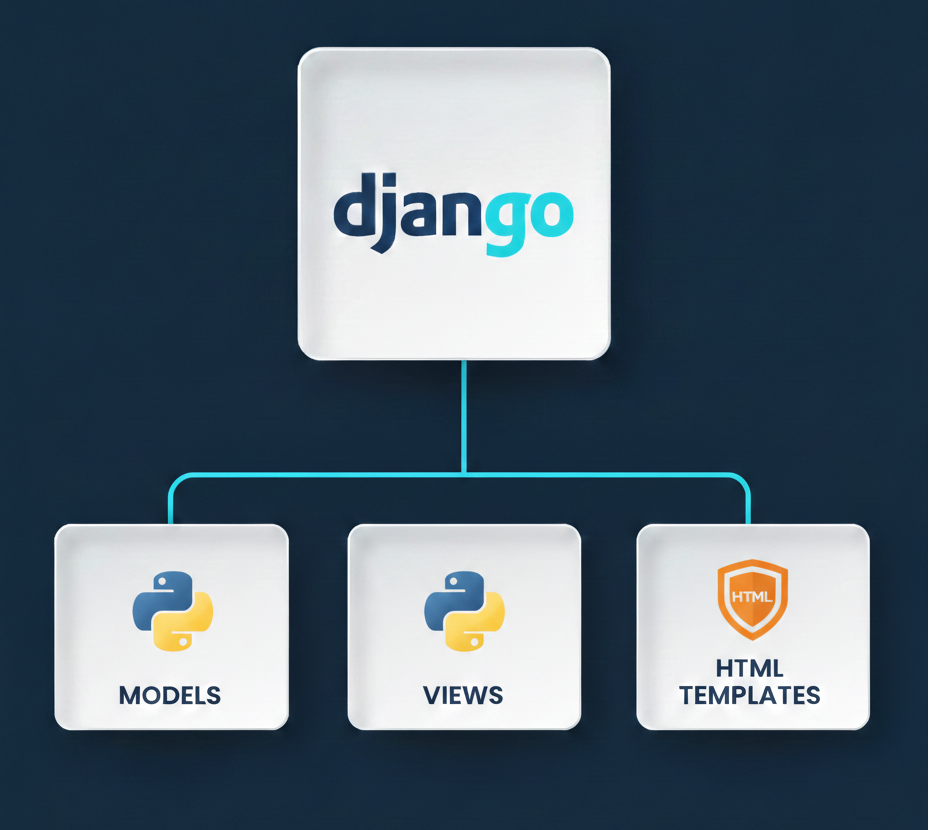
Django utilizes the Model-View-Template (MVT) architecture. This is a slight variation of the traditional MVC pattern, optimized for web development.
- Model: This is the single, definitive source of truth regarding your data. Models are Python classes that map directly to your database tables. They handle all the SQL queries, relations, and data integrity under the hood via the Django Object-Relational Mapper (ORM).
- View: The view is the request-handling mechanism. It receives an HTTP request, processes the necessary business logic, interacts with the Models to fetch or mutate data, and prepares the data to be rendered.
- Template: The template layer handles the presentation logic. It combines standard HTML with Django specific tags to dynamically inject data passed from the View, rendering the final web page sent to the user.
- URL Dispatcher: A URL mapper captures the incoming HTTP request path and routes it to the correct View function based on predefined regex or string patterns.
Core Benefits
- Velocity in Action: The framework is designed for rapid prototyping. Teams can go from concept to functional application in days.
- The Built-In Admin Interface: This is Django’s killer feature. By simply registering a Model, Django automatically generates a secure, production-ready graphical interface for managing your database records.
- Fortified Security: Django actively prevents common security mistakes. It provides built-in protection against SQL injection, cross-site scripting (XSS), cross-site request forgery (CSRF), and clickjacking.
- Enterprise Adoption: The architecture is proven at massive scale. Platforms like Instagram, Spotify, and Pinterest have historically relied on Django to handle millions of concurrent users.
Design Philosophies
- Don’t Repeat Yourself (DRY): Every distinct concept or piece of data must live in exactly one place. Redundancy is aggressively discouraged.
- Explicit is Better Than Implicit: Django limits “magic” in the codebase. The framework forces developers to explicitly state their intentions, making large codebases highly readable for new engineers.
- Loose Coupling: The various layers of the framework (ORM, routing, templating) are independent. They only interact when absolutely necessary, reducing brittle dependencies.
2. FastAPI: The Modern Microservices Engine
FastAPI is a modern, high-performance web framework for building APIs with Python based on standard Python type hints. It abandons the monolithic structure of Django in favor of extreme speed and flexibility.
Architectural Blueprint: ASGI and Pydantic
FastAPI is not a full-stack framework. It is an API builder built on top of two exceptionally fast foundational libraries.
- Starlette (The Web Microframework): FastAPI uses Starlette under the hood for routing, web sockets, and handling the Asynchronous Server Gateway Interface (ASGI). This is what allows FastAPI to handle high concurrency natively.
- Pydantic (Data Validation): FastAPI relies heavily on Pydantic for data parsing and validation. You define your data schemas using standard Python type hints. Pydantic guarantees that the data entering your API matches the exact types you expect, rejecting invalid requests automatically.
- Dependency Injection System: FastAPI includes a powerful, built-in dependency injection system. This allows engineers to easily manage database sessions, authentication checks, and shared logic across different API endpoints without writing redundant wrapper functions.
Core Benefits
- Raw Throughput: Because it is built on ASGI, FastAPI rivals the performance of Node.js and Go. It is ideal for machine learning model serving and high-traffic microservices.
- Automatic Documentation: FastAPI automatically generates interactive API documentation (Swagger UI and ReDoc) directly from your Python code. This eliminates the drift between your actual code and your API documentation.
- Type Safety: The reliance on Python type hints catches a massive class of bugs at development time rather than runtime.
Design Philosophies
- Developer Experience First: The framework is designed to be intuitive. It leverages modern IDE capabilities (like VS Code or PyCharm) to provide excellent auto-completion and type checking.
- Standard-Based: FastAPI is built entirely on open standards like OpenAPI (previously Swagger) and JSON Schema. You are not locked into proprietary framework mechanics.
3. Node.js: The Asynchronous Powerhouse
Node.js is not a framework. It is a runtime environment that allows engineers to execute JavaScript on the server side. Frameworks like Express.js or NestJS are typically built on top of it to handle HTTP routing.
Architectural Blueprint: Event-Driven Non-Blocking I/O
Node.js fundamentally changes how a server handles concurrent connections compared to traditional synchronous Python web servers.
- The V8 Engine: Node.js runs on the V8 JavaScript engine developed by Google. V8 compiles JavaScript directly to native machine code, resulting in exceptional execution speed.
- The Event Loop: This is the heart of Node.js. Instead of spawning a new thread for every incoming request (which consumes significant RAM), Node.js operates on a single main thread.
- Non-Blocking I/O: When Node.js needs to perform a slow operation like reading from a database or a file system, it offloads that task and continues processing other incoming requests. Once the database responds, an event is triggered, and the main thread picks the task back up to send the response.
Core Benefits
- Full-Stack Parity: Engineers can write both the frontend (React, Angular) and the backend (Node.js) in the exact same language. This eliminates context switching and allows for highly fluid engineering teams.
- Real-Time Dominance: The event loop makes Node.js the undisputed king of real-time applications. Chat servers, collaborative editing tools, and heavy websocket applications run flawlessly here.
- The NPM Ecosystem: Node Package Manager (NPM) is the largest software registry in the world. Almost any integration or utility you need has a pre-built package available.
Design Philosophies
- The Unix Philosophy: Node.js encourages building small, single-purpose modules that do one thing perfectly, rather than building massive monolithic architectures.
- Asynchronous by Default: The entire ecosystem assumes asynchronous programming. Engineers must deeply understand callbacks, promises, and async/await patterns to prevent the system from crashing.
Performance Comparison: The Hard Numbers
Raw benchmarks only tell part of the story, but they are crucial for capacity planning. The following table represents expected baseline performance for simple JSON serialization and database querying under high concurrency.
| Metric | Django (Gunicorn/WSGI) | FastAPI (Uvicorn/ASGI) | Node.js (Express) |
| Architecture | Synchronous (Async optional) | Native Asynchronous | Event-driven Async |
| Est. Requests Per Sec (RPS) | 2,500 | 12,000 | 15,000 |
| Average Latency | High | Low | Low |
| Memory Footprint | Heavy (~50MB+ base) | Light (~15MB base) | Moderate (~25MB base) |
| Ideal Workload | Complex relational data | High throughput microservices | High concurrency I/O |
Note: These numbers reflect baseline stress tests. Real-world performance is bottlenecked almost entirely by your database queries and network architecture, not the framework itself.
Nearshore Django Development: Why it Scales
For most US-based startups, the decision to hire nearshore Django developers is driven by the framework’s “DRY” (Don’t Repeat Yourself) philosophy. Django’s rigid structure prevents “spaghetti code,” making it easier to manage distributed teams across time zones.
When analyzing the average software developer salaries in Latin America, Python developers consistently offer the highest ROI for enterprise-grade backends. Because Django enforces standard conventions, a nearshore senior engineer can onboard and commit production-ready code in a fraction of the time required by a bespoke Node.js setup.
The Business Perspective: Talent Economics
Your tech stack dictates your hiring pipeline. If you build a platform in Rust, you will pay a premium for a smaller pool of talent. The choice between Python and JavaScript is a choice about team composition.
JavaScript developers are ubiquitous. Finding a Node.js developer is statistically easier than finding a senior Python engineer. However, Python has become the lingua franca of data science and artificial intelligence. If your product roadmap includes integrating LLMs, predictive analytics, or heavy data pipelines, standardizing your backend on Python eliminates the need to build complex bridges between a Node.js backend and Python microservices.
How to Hire Django Developers for Engineering Velocity
Hiring for “Django” is actually hiring for discipline. You need engineers who understand:
- ORM Optimization: Preventing the N+1 query problem.
- Security Protocols: Leveraging built-in middleware for CSRF and XSS.
- Scalability: Migrating from a monolith to a decoupled frontend (React/Vue) using Django REST Framework.
If your product roadmap includes integrating AI or heavy data processing, the argument for Python becomes undeniable. It allows your backend team and data science team to share a single language, reducing the architectural friction common in Node.js environments.
The Final Decision Matrix
Use this matrix to guide your architectural decision:
- Choose Django if: You are building a complex marketplace, need an MVP launched in weeks, require a robust admin panel from day one, and plan to hire Django developers to scale a predictable, unified monolith.
- Choose FastAPI if: You are building an ecosystem of microservices, need to serve machine learning models, and require massive throughput with strict type validation.
- Choose Node.js if: Your application requires real-time websocket connections, your team is completely composed of JavaScript experts, and you are building an I/O heavy API gateway.