Right now, a US engineering leader is staring at a Slack channel where it’s 11pm for their offshore team and 9am for everyone who actually needs an answer. They’re doing the math on what another missed handoff costs, and they’ve started typing “nearshore AI engineers” into a search bar. If that’s you, this report is the math.
Hire the best developers in Latin America. Get a free quote today!
Contact Us Today!This is a report on the real cost of hiring a nearshore AI engineer versus a US hire in 2026
We analyzed advertised salaries across 256 senior AI engineering job postings in the US — Agentic AI, LLM/RAG, Computer Vision, and MLOps — from April and May 2026. Alongside each one, we’ve put the all-in cost for the same role through Next Idea Tech: what a US company actually pays us to embed a senior nearshore LATAM engineer with the same skills into their team.
The goal isn’t another salary table. It’s to answer the three questions every US buyer actually asks before they commit
- What does senior AI engineering talent really cost in 2026?
- What’s the all-in nearshore alternative once you account for everything
- Is the skill set actually equivalent? Here’s the short version
Here’s the short version — and the rest of this report backs each piece with the data. The US AI engineering market is paying $190K–$223K median base across the four specializations we tracked, with the 75th percentile pushing past $260K on the high end. The all-in nearshore cost — engineer comp, benefits, compliance, and our flat management fee — lands between $114K and $134K depending on specialization, a 38–42% reduction with no equity dilution and no hidden total-comp surprises. And the skills required in nearshore senior roles match the US postings one for one, because the cost gap is economics, not capability.
What US companies pay for senior AI engineers in 2026
If you’re budgeting for an AI hire in 2026, you’re not budgeting against the average software engineer salary. You’re budgeting against the AI-specialist premium — a band that sits noticeably above general senior engineering and that’s stayed stubbornly elevated through the talent crunch of the past two years. Here’s what 211 senior AI job postings from April and May 2026 actually show.
Three things to read out of that chart, in order of how much they matter to a hiring budget:
1. The medians cluster tightly — and that’s the signal, not the noise. RAG, MLOps, and generative AI all land within about $12,000 of each other ($181K–$193K). The market is treating these as effectively one premium tier. If you’ve been wondering whether to budget separately for “an LLM engineer” versus “an MLOps engineer,” the data says don’t bother — they cost roughly the same. The differentiation that matters for your budget isn’t which AI specialty, it’s what seniority.
2. The interquartile range is where the real money is. Look at the spread, not just the medians. The 75th percentile pushes past $220,000 across the board (RAG hits $221K, MLOps hits $225K, generative AI hits $218K). That means a quarter of senior AI postings in our sample are advertising above $220K in base alone — and that’s before equity, bonuses, and sign-ons that typically push total compensation 20–40% higher at well-funded companies. If you’re hiring in NY or SF, you’re competing against that 75th percentile, not the median.
3. The 25th percentile is still a real number. Even the bottom of the senior AI band — the $144,800 floor on generative AI postings, the $162,448 floor on MLOps — represents a meaningful budget commitment. There is no “cheap senior AI hire” in the US market in 2026. The talent crunch has compressed the low end. Companies hoping to find a senior AI engineer for $120K are looking in a market that doesn’t exist anymore.
The buyer takeaway: Budget for an AI hire in 2026 means budgeting against a tight, elevated band — $180K median, $220K+ at the 75th percentile, with the floor compressed up to $145K. The specialization (RAG vs MLOps vs generative AI) barely moves the number. If your budget is below the 25th percentile, you’re not hiring senior in this market — you’re hiring junior labeled as senior, which is the more expensive mistake.
That’s what the open market costs. The next section is what changes when you don’t hire on the open US market at all.
What the same role costs through Next Idea Tech
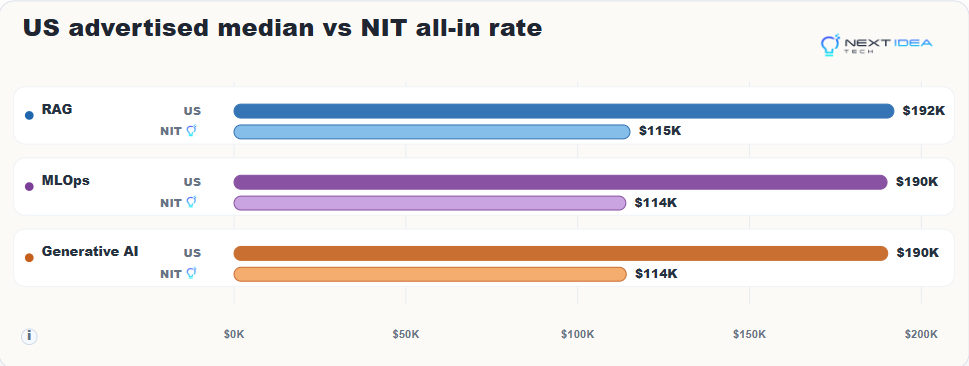
Here’s the comparison the rest of this report is about. The same three senior AI specializations — RAG, MLOps, generative AI — placed through Next Idea Tech as embedded LATAM nearshore engineers, all-in.
Three things worth pulling apart in that comparison, because the way it’s structured matters as much as the numbers themselves.
1. The two columns are not the same kind of number — and the asymmetry favors you. The US column is advertised base salary — the number employers post publicly. That excludes equity, sign-on bonuses, and annual bonuses, which at well-funded AI companies typically add another 20–40% on top. A $223,000 advertised Agentic AI role is realistically a $270K–$310K total-comp commitment once you sign someone. The Next Idea Tech column is the complete number — engineer compensation, benefits, EOR and compliance, and a flat management fee, all in. No equity to dilute the cap table. No bonus pool to budget for. No separate line for benefits. What you see is what you pay. The real gap is wider than the chart suggests, because the US bar is incomplete and the NIT bar isn’t.
2. The pricing scales with the skill — and that’s how honest pricing should look. Agentic AI is the most expensive specialization on both sides ($223K US, $134K NIT). MLOps is the least expensive on both ($190K US, $114K NIT). The NIT rate tracks the market because the engineers we place are paid the market rate for their specialization — there’s no flat markup obscuring that. The savings percentage holds remarkably steady across the four roles (38–42%), which is what you’d expect when both columns are responding to the same underlying labor market dynamics. If you’re hiring an Agentic AI engineer, the absolute savings are larger ($89K per hire); if you’re hiring MLOps, the percentage savings are larger (40%). Either way, you’re paying the same kind of premium ratio you’d pay on the open US market, against a lower base.
3. The pricing model itself is the differentiator — and it answers a question buyers are explicitly searching for. A buyer typed this into Google recently: “which nearshore staff augmentation companies publish a flat management fee separate from engineer salary for US startups?” That question gets typed because most nearshore firms quote a blended rate — one opaque number combining engineer pay and firm markup, with no way to tell how much goes to the engineer vs. the middleman. Next Idea Tech doesn’t operate that way. Our rate breaks out engineer compensation, benefits, EOR/compliance, and a transparent flat management fee. You see what the engineer earns. You see what the management layer costs. That transparency is the model, not a feature of it.
The buyer takeaway: A senior AI engineer through Next Idea Tech costs roughly $114K–$134K all-in, depending on specialization, against a US advertised median of $190K–$223K base that becomes $230K+ total comp once equity and bonus are layered on. The savings sit between $76K and $89K per engineer per year, every year — and that’s against the base number, before equity. For a typical AI team build (3–5 engineers), that’s roughly an additional senior headcount you can fund without raising more money or expanding the budget. Agentic AI, where the gap is widest in absolute dollars, is where the math is hardest to ignore.
Same skills, lower cost: why the gap is economics, not capability
Every US buyer reading the cost comparison has the same next thought: “okay, but is it actually the same engineer?” It’s the right question. A 40% cost reduction would be suspicious if it came from a watered-down version of the role. Here’s what the data says about whether it does.
We compared the skill requirements published in senior AI job postings on both sides of the border — US postings advertising RAG, MLOps, LLM, Agentic AI, and Computer Vision roles, against LATAM postings advertising the same titles. The question was simple: do these roles ask for the same things?
The short answer is yes, and tightly so. The skill tags that appear in senior US AI postings appear in senior LATAM postings at nearly identical frequencies. PyTorch — now the dominant framework in production AI roles — shows up in roughly the same share of postings in both regions. So does the modern LLM orchestration stack: LangGraph and LangSmith (the LangChain ecosystem’s current center of gravity), LlamaIndex for RAG-heavy work, and the emerging Agent SDKs and MCP integrations that are starting to replace older framework code in 2026 senior job specs. The MLOps stack matches across the border too — MLflow for experiment tracking and model registry, Kubeflow for pipeline orchestration, and one of the managed platforms (SageMaker, Vertex AI, or Azure ML) on top. And the production-AI requirements that separate senior from mid — eval design with LangSmith or Braintrust, RAG with hybrid retrieval and reranking, fine-tuning with LoRA or QLoRA, inference cost optimization with vLLM or SGLang — show up at the same rates in both regions, because senior AI engineers are shipping the same systems for the same kinds of US companies.
This is the part most cost-arbitrage stories quietly skip. A pitch that says “same talent, half the cost” usually doesn’t show the data because the talent isn’t actually the same — it’s a lower-seniority engineer, a different stack, or a generalist labeled as a specialist. The gap exists in our numbers precisely because the engineer doesn’t. What changes between the US and LATAM columns isn’t the engineer’s skill set, the engineer’s seniority, or the engineer’s track record of production AI work. What changes is cost of living, currency exchange, and the size of the local tech labor market.
Three things worth being specific about, because vague claims about “equivalent talent” are exactly the kind of marketing that buyers learn to discount.
1. The seniority bar is the same on both sides. Every engineer Next Idea Tech places has shipped production AI systems under live traffic. We don’t backfill “senior” requirements with strong mid-level engineers — that’s the single most common arbitrage trick in nearshore staffing and we don’t do it. If a buyer briefs us for senior, we send senior; if we don’t have a senior match on the bench, we say so. The vetting process is the proof: every candidate is interviewed by a senior AI engineer on our team, not a recruiter with a scorecard, and asked to build something real (a small RAG pipeline, an eval harness, a fine-tuning workflow) live, while we watch how they think. Engineers who can talk about LLMs but haven’t shipped one don’t pass that interview.
2. The skill recency matches too. This is a subtler point but it shows up in our data. The fastest-rising skills in US senior AI postings over the past 12 months — agentic frameworks, LangGraph, eval harnesses, RAG with hybrid retrieval, vLLM-based inference optimization — appear in LATAM postings at comparable rates over the same window. The LATAM AI engineering talent pool isn’t a year behind the US frontier; it’s tracking it in roughly real-time, because the engineers who care about staying current learn the same tools from the same papers, blog posts, and open-source repos as their US counterparts. Geography doesn’t gate access to Anthropic’s documentation or LangChain’s GitHub.
3. The cost gap is structural, not qualitative. A senior AI engineer in Buenos Aires or São Paulo earns less than a senior AI engineer in San Francisco for the same reason a senior AI engineer in Pittsburgh earns less than one in San Francisco: local cost of living and the size of the local employer market for their skills are different. That’s economics. It’s not a judgment about the engineer. A buyer who tries to hire a $223K Agentic AI engineer in San Francisco for $134K will fail. A buyer who hires the equivalent engineer in São Paulo at $134K all-in succeeds — not because the engineer is worth less, but because the engineer’s $134K covers a different cost-of-living base.
The buyer takeaway: The cost gap between US and LATAM AI engineers isn’t a quality gap masquerading as a cost gap. The skill stack is the same. The seniority bar is the same. The recency of the technology they work with is the same. The thing that’s different is the local labor market that produced them. That distinction is worth getting clear on before any other conversation about nearshore hiring, because every other claim — fast time-to-hire, retention, integration with your team — rests on the talent actually being equivalent. We’re starting with that one because it’s the question every honest buyer asks first.
How the pricing actually works
Here’s the question every buyer asks once the cost comparison lands: “okay, but what’s in that number?” It’s the right question. A surprisingly large fraction of nearshore engagements that look cheap on paper get expensive in practice — scope-of-work games, time-and-materials creep, surprise line items for “onboarding” or “account management,” equity asks layered on top, or blended rates with a markup floating somewhere inside.
Next Idea Tech doesn’t operate that way. The pricing model is one flat number per engineer per month. That number is your full cost. There is no second invoice, no separate management fee, no expenses to true up at quarter-end. What you put in your budget is what you pay all year. Here’s what that flat number actually covers.
What’s in the price:
- Engineer compensation. Senior production AI engineers, paid at competitive LATAM senior market rates for their specialization. The engineers we place are paid what it takes to keep senior people on the bench — not the bottom of the market.
- Benefits. Health coverage, paid time off, statutory benefits per the engineer’s country of residence. Handled by us, paid by us, fully compliant with local law. You don’t manage any of it.
- Employer of Record (EOR). We are the legal employer in Brazil, Argentina, Colombia, and Mexico. Local labor law, payroll, taxes, statutory contributions, termination compliance — ours to handle. You contract with one US entity (us) and get an engineer in LATAM without standing up a foreign subsidiary or hiring a separate EOR vendor.
- IP assignment and NDAs. Signed directly with every engineer before they touch your codebase. The IP your engineer produces is yours from day one, with clean assignment chains that hold up in US contract disputes.
- The bench and the match. The cost of maintaining a pre-vetted senior AI engineering bench so we can interview-ready candidates inside 72 hours, plus the engineering-led vetting process. You’re paying for the curation, not just the headcount.
- Replacement coverage. If the placement isn’t working in the first two weeks, we replace the engineer or refund. The cost of carrying that risk is inside the rate.
What’s not in the price:
- Equipment, when the engineer’s existing setup doesn’t meet your security or hardware requirements. If you need a specific laptop, monitor configuration, or hardware-secured environment, we arrange the shipment and pass through the actual cost — no markup. Most placements never need this.
- That’s the entire list. No “onboarding fees.” No “transition fees.” No “account management” line items. No surprise expenses.
The buyer takeaway: One number per engineer per month, locked in, all in. The engineer is paid competitive senior rates for their specialization. Benefits, EOR, IP, and replacement are handled. The only carve-out is equipment for specific security needs, and that’s at cost. If you’re modeling a budget for next year’s AI hiring, the line item is “$X per engineer × 12 months × Y engineers,” and that’s the whole spreadsheet.
The flat-price model is the answer to a question we see buyers explicitly searching for on Google: “which nearshore staff augmentation companies publish a flat management fee separate from engineer salary?” The honest answer is that the question assumes a billing model that doesn’t apply to us. We don’t break out a separate management fee because there isn’t one — the price is the price. No markup riding on top, no scope creep, no surprise invoices. Engineers are paid at LATAM senior market rates for their specialization; the spread between what they earn and what you pay covers the operating costs of running the staff augmentation: benefits, EOR, compliance, the vetting process, the bench, and the replacement guarantee. You don’t see a line-item breakdown because there isn’t a second line to itemize.
What this means for your 2026 AI hiring plan
You’ve now seen the cost picture (Section 1), the all-in nearshore alternative (Section 2), why the talent is genuinely equivalent (Section 3), and what’s actually inside the price (Section 4). Pull it together and the strategic picture is straightforward.
Senior AI engineering compensation in the US is up and staying up. $190K–$223K median base, $260K+ at the 75th percentile, and total comp climbing past $350K once equity and bonuses layer on at well-funded companies. That’s the new floor. It’s not coming back down — the talent pool is too small, the demand is too concentrated, and the hyperscalers are absorbing experienced engineers faster than the market produces them. If your 2026 AI hiring plan is built around 2023 budget assumptions, it’s already broken.
Nearshore LATAM is the structural answer, not a tactical one. It’s not “cheaper AI engineers” — it’s the same skill set, the same seniority bar, the same production stack, sourced from a labor market with different cost-of-living economics and zero equity expectation. The all-in cost lands between $114K and $134K depending on specialization. The savings, conservatively against US base alone, run $76K–$89K per engineer per year — closer to $130K once you include the equity and bonus the US column doesn’t show. For a team building three to five AI engineers in 2026, that’s roughly an additional senior headcount you can fund without raising more money.
The hiring math that actually matters in 2026 isn’t “what does a senior AI engineer cost?” It’s “what’s the most senior production AI talent we can fund inside our current envelope?” For most US engineering teams, the honest answer to that question is: more than you think, if you stop hiring exclusively in the US.
Get matched in 72 hours
If you’re hiring senior AI engineers in 2026 — LLM, RAG, agentic, MLOps, computer vision, or fine-tuning — and the math in this report changes your thinking, we’d like to send you matched candidates.
One short brief on your stack, the role you’re trying to fill, and your timeline. We come back inside 72 hours with two to three pre-vetted senior engineers from our bench, matched to your specialization and time zone. You interview them directly. If the placement isn’t working in the first two weeks, we replace or refund.
No long sales process. No account-management layer. Direct line to the founder.
Tell us what you’re hiring for →
Or browse the AI specializations: LLM Engineers · ML Engineers · Agentic AI Engineers · All AI Engineering